ERP vs CRM: Understanding the Difference – Which Business Software Does Your Company Need?
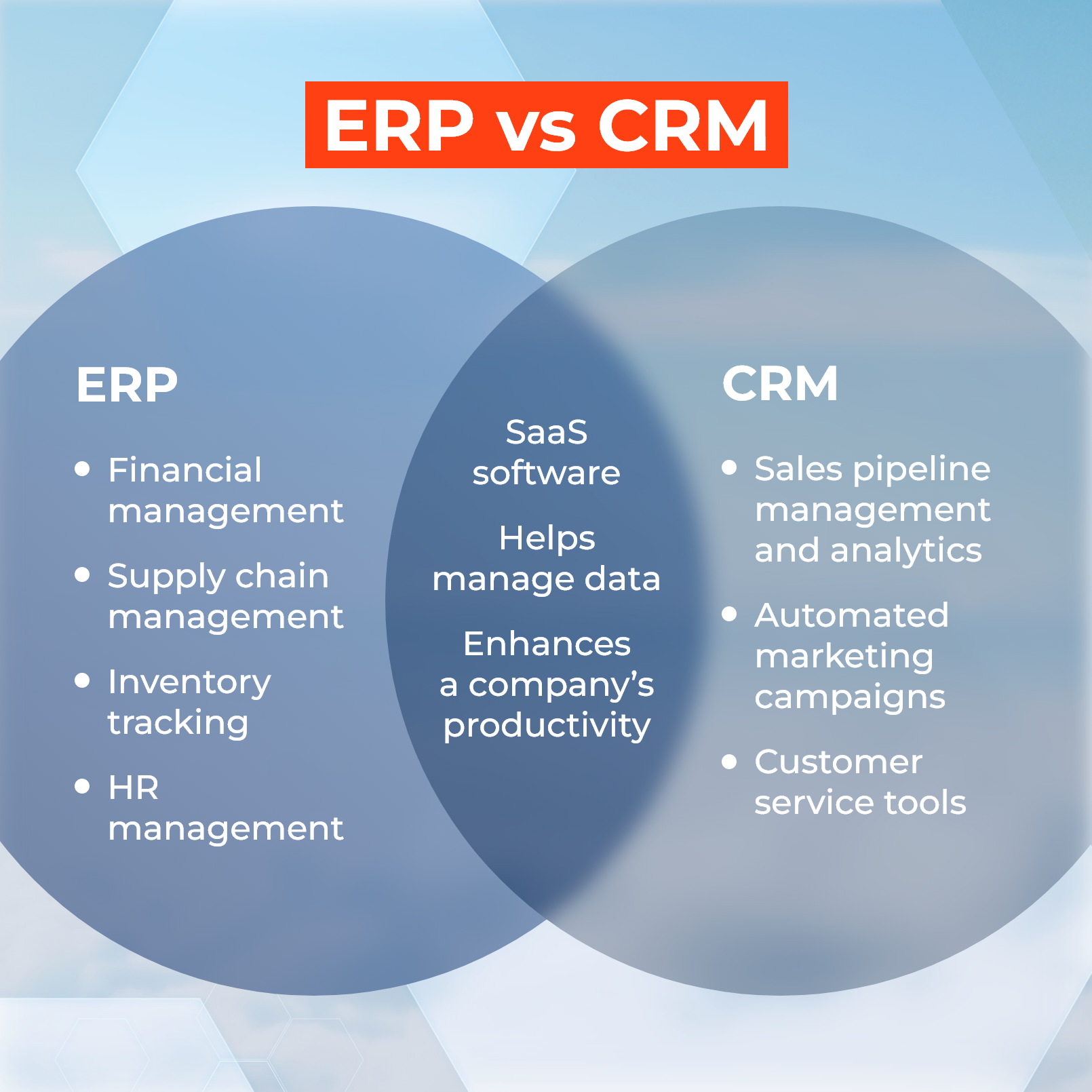
Although Enterprise Resource Planning (ERP) and Customer Relationship Management (CRM) systems are both designed to improve business performance, they serve very different purposes. An ERP system focuses on managing internal business operations, while a CRM system helps businesses build stronger relationships with customers and improve sales performance.
Choosing the right solution—or integrating both—can significantly improve productivity, decision-making, and overall business growth. This guide explains the key differences between ERP and CRM, their benefits, and how businesses can determine which solution best fits their needs.
What Is ERP?
Enterprise Resource Planning (ERP) is business management software that integrates core organizational processes into a single centralized system.
ERP solutions typically manage:
- Finance and Accounting
- Inventory Management
- Human Resources
- Procurement
- Supply Chain Management
- Manufacturing
- Project Management
- Business Reporting
Instead of using separate software for each department, ERP connects them through one unified platform, improving collaboration and operational efficiency.
What Is CRM?
Customer Relationship Management (CRM) software focuses on managing customer interactions and improving the entire customer lifecycle.
CRM systems help businesses:
- Manage customer information
- Track sales opportunities
- Automate marketing activities
- Monitor customer communication
- Improve customer support
- Analyze customer behavior
- Increase customer retention
Unlike ERP, which primarily manages internal operations, CRM is designed to strengthen relationships with prospects and existing customers.
ERP vs CRM: The Core Difference
The biggest difference between ERP and CRM lies in their primary purpose.
ERP focuses on improving internal business operations by integrating departments and automating workflows.
CRM focuses on improving external business relationships by managing leads, customers, sales, and support activities.
While ERP helps businesses operate more efficiently, CRM helps businesses generate more revenue through stronger customer engagement.
Many growing organizations eventually integrate both systems to create a complete digital business ecosystem.
Feature Comparison: ERP vs CRM
| Feature | ERP | CRM |
|---|---|---|
| Primary Focus | Business Operations | Customer Relationships |
| Main Users | Finance, HR, Operations | Sales, Marketing, Customer Support |
| Core Objective | Operational Efficiency | Revenue Growth |
| Data Managed | Business Processes | Customer Information |
| Inventory Management | Yes | No |
| Sales Pipeline | Limited | Yes |
| Customer Support | Basic | Advanced |
| Financial Reporting | Yes | Limited |
This comparison shows that ERP and CRM solve different business challenges while complementing each other.
Benefits of ERP Systems
One of the biggest advantages of ERP software is centralized business management.
Organizations using ERP systems benefit from:
- Improved operational efficiency
- Better financial management
- Automated workflows
- Real-time reporting
- Inventory optimization
- Stronger compliance
- Improved collaboration across departments
By eliminating disconnected systems, ERP helps businesses make faster and more informed decisions.
Benefits of CRM Systems
CRM software focuses on improving customer engagement and increasing sales performance.
Key CRM benefits include:
- Better lead management
- Personalized customer communication
- Sales automation
- Marketing campaign management
- Customer support tracking
- Improved customer retention
- Sales forecasting
Businesses using CRM systems often experience stronger customer relationships and higher conversion rates.
Practical Example
Imagine a manufacturing company with a growing customer base.
The sales team uses a CRM system to manage leads, schedule follow-ups, track customer interactions, and monitor sales opportunities.
Meanwhile, the operations team uses an ERP system to manage production schedules, inventory levels, supplier relationships, employee resources, and financial reporting.
When a customer places an order, the CRM records the sales activity while the ERP automatically updates inventory, generates invoices, schedules production, and manages shipping.
This integration creates a seamless workflow that improves both customer satisfaction and operational efficiency.
When Should Businesses Choose ERP?
Businesses should consider ERP when they need to:
- Manage multiple departments
- Improve inventory control
- Automate accounting processes
- Streamline procurement
- Monitor financial performance
- Improve operational efficiency
- Support business expansion
ERP becomes increasingly valuable as organizations grow and internal processes become more complex.
When Should Businesses Choose CRM?
CRM is the better choice when businesses want to:
- Increase sales
- Improve customer relationships
- Track leads more effectively
- Automate marketing campaigns
- Improve customer support
- Increase customer retention
- Gain better customer insights
Companies focused on revenue growth often begin with CRM before expanding into ERP solutions.
Key Takeaways
Understanding ERP vs CRM: Understanding the Difference begins with recognizing their different objectives.
ERP improves internal business operations by integrating departments and automating workflows, while CRM strengthens customer relationships, improves sales performance, and enhances customer engagement.
Rather than competing technologies, ERP and CRM complement each other and together create a more connected, efficient, and customer-focused business.
Can ERP and CRM Work Together?
One of the biggest misconceptions is that businesses must choose between an ERP or a CRM system. In reality, these two solutions complement each other and deliver even greater value when integrated.
A CRM system manages customer interactions, sales opportunities, and support requests, while an ERP system handles inventory, finance, procurement, production, and other internal operations.
When integrated, information flows seamlessly between departments. For example, once a sales representative closes a deal in the CRM system, the ERP automatically processes the order, updates inventory, generates invoices, and schedules delivery. This eliminates duplicate data entry, reduces manual errors, and improves overall business efficiency.
How to Decide Between ERP and CRM
Choosing the right solution depends on your business goals and operational challenges.
If your biggest challenge is managing internal operations, finance, inventory, or production, an ERP system is usually the better choice.
If your focus is improving customer relationships, increasing sales, managing leads, or enhancing customer service, a CRM solution will provide greater value.
Many medium-sized and large organizations eventually implement both systems to create a unified digital ecosystem that supports every stage of the business process.
Actionable Tips Before Implementing ERP or CRM
Before investing in business software, carefully evaluate your existing processes and identify areas where technology can deliver measurable improvements.
Define clear business objectives and involve stakeholders from multiple departments during the planning phase. Choosing software based solely on features rather than business needs often leads to poor adoption.
Begin with the highest-priority processes, provide adequate employee training, and monitor system performance after implementation.
Businesses with unique workflows often achieve better results by investing in Custom Software Development Services, where ERP or CRM solutions are designed specifically around organizational requirements instead of relying entirely on generic platforms.
Common Mistakes Businesses Should Avoid
One common mistake is assuming ERP and CRM perform the same function.
Another mistake is implementing software without first analyzing existing business processes. Automating inefficient workflows rarely improves productivity.
Organizations also underestimate the importance of employee training. Even the best software cannot deliver results if users do not understand how to use it effectively.
Ignoring data quality, skipping system integration, and failing to establish clear implementation goals are additional mistakes that can reduce project success.
Regular software updates and continuous process improvements are equally important for maximizing long-term value.
Best Practices for ERP and CRM Implementation
Successful implementation begins with careful planning.
Start by documenting business requirements and selecting software that supports future growth rather than just current needs.
Ensure data is cleaned before migration to avoid transferring outdated or inaccurate information.
Integrate ERP and CRM with existing business systems wherever possible to eliminate duplicate work and improve data consistency.
Measure key performance indicators such as operational efficiency, customer satisfaction, sales growth, and process automation to evaluate the success of the implementation.
Ongoing user training and periodic system reviews help ensure the software continues to meet changing business requirements.
Future of ERP and CRM Systems
The future of ERP vs CRM: Understanding the Difference is increasingly influenced by Artificial Intelligence, cloud computing, automation, predictive analytics, and machine learning.
Modern ERP systems are becoming more intelligent through automated financial forecasting, inventory optimization, and workflow automation.
CRM platforms are evolving with AI-powered customer insights, predictive lead scoring, personalized marketing, intelligent chatbots, and automated customer support.
Cloud-based ERP and CRM solutions are also making enterprise-level technology more accessible to small and medium-sized businesses by reducing infrastructure costs and enabling remote collaboration.
Businesses adopting these technologies today will be better prepared for future digital transformation initiatives.
Key Takeaways
Understanding ERP vs CRM: Understanding the Difference helps businesses select technology that aligns with their operational goals.
ERP improves internal business processes by managing finance, inventory, procurement, and operations, while CRM focuses on customer relationships, sales, marketing, and support.
Rather than replacing one another, ERP and CRM work best together, providing organizations with complete visibility across both internal operations and customer interactions.
Conclusion
ERP and CRM systems play different but equally important roles in business success. ERP enables organizations to streamline operations, improve efficiency, and gain better control over internal processes. CRM helps businesses strengthen customer relationships, improve sales performance, and deliver personalized customer experiences.
The right choice depends on your organization's current priorities, business size, and long-term growth strategy. Smaller businesses may begin with CRM to improve customer engagement, while organizations managing complex operations often benefit from ERP. As companies grow, integrating both systems creates a unified business environment that supports smarter decision-making and sustainable growth.
Investing in the right technology today lays the foundation for greater productivity, improved collaboration, and stronger competitive advantage in the future.
Call to Action
Planning to modernize your business operations? Evaluate your organization's goals, identify operational challenges, and choose technology that supports long-term growth. Whether you need an ERP system, a CRM platform, or an integrated solution, selecting the right software can improve efficiency, strengthen customer relationships, and accelerate digital transformation.
Frequently Asked Questions (FAQs)
1. What is the main difference between ERP and CRM?
ERP manages internal business operations such as finance, inventory, procurement, and HR, while CRM focuses on customer relationships, sales, marketing, and customer support.
2. Which businesses need ERP software?
Businesses managing complex operations, multiple departments, inventory, manufacturing, finance, or supply chains benefit most from ERP systems.
3. Who should use CRM software?
Organizations focused on improving sales, customer engagement, lead management, marketing automation, and customer support should consider CRM software.
4. Can ERP and CRM be integrated?
Yes. Integrating ERP and CRM enables seamless data sharing between customer-facing teams and internal business operations, improving efficiency and reducing manual work.
5. Is ERP better than CRM?
Neither is inherently better. ERP and CRM serve different purposes, and many businesses achieve the best results by using both together.
6. Is cloud-based ERP or CRM better than on-premises software?
Cloud-based solutions offer greater flexibility, scalability, lower infrastructure costs, and easier remote access, making them a popular choice for modern businesses.
7. How long does ERP or CRM implementation take?
Implementation timelines vary depending on business size, customization requirements, data migration, and system complexity. Projects can range from a few weeks to several months.
8. What technologies are shaping the future of ERP and CRM?
Artificial Intelligence, machine learning, predictive analytics, automation, cloud computing, and advanced business intelligence are transforming modern ERP and CRM platforms.